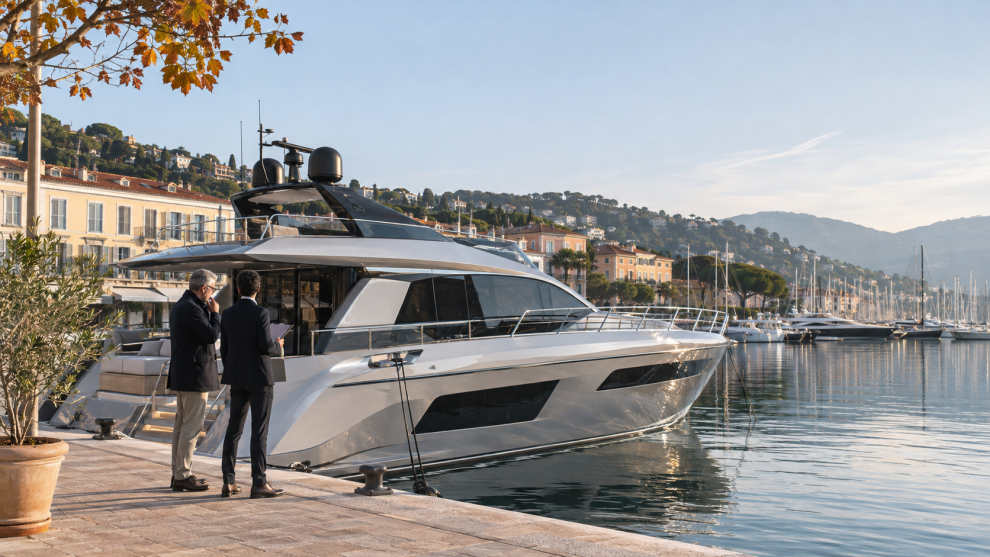
Buying a yacht does not necessarily begin with the summer season. Autumn and winter can provide a useful opportunity for a more focused search, technical due diligence and negotiations.
Outside the high season, buyers have more scope to look beyond design, speed and the first impression of a yacht’s decks and concentrate instead on technical condition, maintenance history, future running costs and how the yacht will actually be used.
This does not mean yachts are automatically cheaper in winter or that every seller is prepared to negotiate. The main advantage of the off-season is not a guaranteed discount, but a more measured decision-making process.
The Search Can Become More Focused in Winter
During the high season, many yachts are being actively used by their owners, operating on charter or moving regularly between Mediterranean ports.
In autumn and winter, part of the fleet returns to its regular berth or enters scheduled maintenance. For prospective buyers, this can make viewings easier to organise and allow more time to examine a particular yacht in detail.
More importantly, the off-season can make it easier to separate the emotional appeal of a yacht from the practical questions that ultimately determine whether it is the right purchase.
Does the layout genuinely suit your family? Is there enough space for longer cruises? Will you need permanent crew? Where will the yacht be based? How much time do you realistically expect to spend on board?
The answers to these questions are ultimately more important than the first impression alone.
Do Not Start with the Brand — Start with How You Will Use the Yacht
One common mistake among prospective owners is to begin the search with a particular shipyard, model or yacht length.
A more effective approach is to first define how the yacht will actually be used.
Short coastal trips between Monaco, Cannes and Saint-Tropez create one set of requirements. Spending several weeks around Corsica or Sardinia, or undertaking longer Mediterranean itineraries, creates another.
The number of guests and cabins, permanent crew requirements, exterior deck space, tender and water toys, stabilisers, cruising autonomy and intended home port can all influence the choice.
Once the intended use has been clearly defined, the shortlist of suitable yachts generally becomes much shorter — and considerably more relevant.
The Off-Season Is Well Suited to Technical Due Diligence
Professional photographs and a broker’s presentation provide only part of the information needed to evaluate a yacht.
Before buying a yacht, it is essential to understand the vessel’s actual technical condition. For a pre-owned yacht, this includes maintenance history and the condition of the engines, generators, hull, navigation equipment, air-conditioning systems, electrical systems and other critical components.
Once a buyer moves into serious negotiations, an independent pre-purchase survey will normally become an important part of the process.
Depending on the yacht and the terms of the transaction, this may include inspections both afloat and ashore, a review of technical documentation and testing of onboard systems.
A sea trial is also an important part of the evaluation. Running the yacht makes it possible to assess engine performance, noise and vibration levels, stabilisers and the vessel’s behaviour underway.
During winter, a sea trial will depend on weather conditions, the yacht’s technical status and its current location, so these checks should be planned in advance.
Can You Get a Better Price in Winter?
Sometimes. But a purchasing strategy should not be based on the assumption that every yacht seller automatically offers a winter discount.
Owners sell for different reasons.
One owner may be willing to discuss terms before the next season begins. Another may have no urgency to sell. A third may have recently invested substantially in maintenance and have little interest in reducing the asking price.
The seller’s individual position is therefore more important than the season itself.
A strong negotiating position comes from understanding the market, knowing the yacht’s condition, having the financial capacity to proceed and being able to move from initial interest to a concrete offer.
This is also where an experienced broker can add particular value: the published asking price and the actual negotiating position are not always the same thing.
The Purchase Price Is Only Part of the Budget
Before making an offer, buyers should consider more than the yacht’s acquisition price.
Ownership involves recurring expenditure on maintenance, insurance, marina berthing, crew, fuel, winter works, administration and periodic repairs.
The larger and more technically complex the yacht, the more important it becomes to view ownership as a long-term project rather than simply an initial purchase.
Two yachts with the same asking price can therefore have very different real-world operating budgets.
Berthing is another important consideration. On the French Riviera, the choice of home port can significantly influence how practical the yacht is to use. For an owner spending most of their time between Monaco and Saint-Tropez, logistics may matter almost as much as the yacht’s technical specification.
New or Pre-Owned Yacht?
The off-season also provides time to compare these two options carefully.
A new yacht offers a current specification and equipment package and, depending on the project, may allow the owner to personalise the interior and certain technical features. It also comes with a different budget and delivery timeline.
A pre-owned yacht may be available considerably sooner, and its operational history already exists and can be assessed. This makes technical due diligence particularly important.
There is no universally correct choice.
If the priority is to have a yacht ready for the following summer, timing can become decisive. If the buyer is prepared to wait for a particular model or customised configuration, a new-build project may make more sense.
When Should You Start Looking for a Yacht for Next Summer?
If you would like to be cruising aboard your own yacht next summer, November is certainly not too early to begin the search.
Time should be allowed for viewing several yachts, negotiations, the technical survey, transaction formalities, any post-purchase maintenance and preparation of the yacht for its new owner.
The closer the high season gets, the less room remains for careful comparison and unhurried decisions.
A productive yacht search therefore begins not simply with the question “Which yacht should I buy?” but with a more useful one: “Which yacht genuinely suits my lifestyle and my plans at sea?”
Find a Yacht to Buy
Yacht ServiceAzur can assist you with the selection and purchase of a yacht on the French Riviera.